Subterranean termites, predominantly the eastern subterranean termite (*Reticulitermes flavipes*) and the invasive Formosan subterranean termite (*Coptotermes formosanus*), live in subterranean nests up to 10 feet…
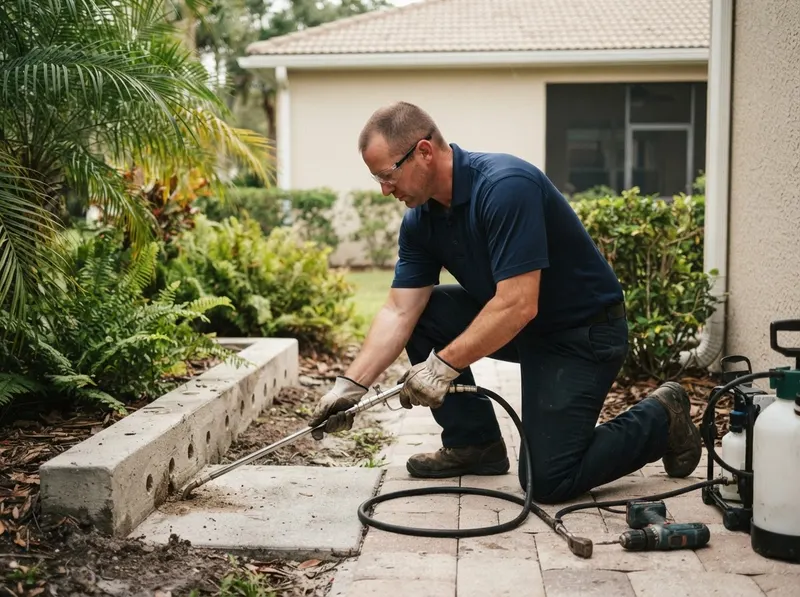
Subterranean termites, predominantly the eastern subterranean termite (*Reticulitermes flavipes*) and the invasive Formosan subterranean termite (*Coptotermes formosanus*), live in subterranean nests up to 10 feet below ground. In Central Florida, sandy soils, humid wet seasons, and elevated groundwater tables allow colonies numbering between 300,000 and several million workers to tunnel through foundation expansion joints, utility pipe conduits, and stucco weep screeds. A standard retail spray repels surface workers, causing the colony to branch outward into alternative joists, whereas a non-repellent liquid barrier creates an undetectable continuous zone that workers track directly into the core nest.
Subterranean termite treatment costs in Orlando depend on linear footage, slab architecture, and foundation access. Monolithic slab homes common in Lake Nona, Hunter's Creek, and Dr. Phillips require trenching into adjacent soil at a depth of 6 inches and a width of 6 inches, followed by targeted pressure-rodding along exterior stem walls. Historical crawlspace homes built on stem walls or pier foundations throughout College Park, Delaney Park, and Thornton Park require both interior perimeter trenching under crawl clearances and exterior trenching, which increases application volume. Poured patios, paver walkways, and attached carports require precise masonry drilling at 12-inch intervals along structural cold joints to establish an unbroken barrier around internal water lines.
Decision guidance dictates that structural liquid treatments fit homes with confirmed active mud tubes on stem walls, sheetrock blister tracks, or concrete cold-joint breaches. In contrast, in-ground cellulose baiting stations fit perimeter monitoring on properties bordered by retention ponds or conservation buffers where soil trenching encounters extensive root networks, such as heavily shaded parcels in Baldwin Park, Audubon Park, MetroWest, or Rosemont. The trade-off involves immediate perimeter saturation via trench injection versus progressive bait consumption over 60 to 90 days, with liquid barriers maintaining detectable soil efficacy for 5 to 8 years.
Treatment execution follows three sequential steps: first, a technician measures the structure's exact perimeter running feet and inspects baseboards with thermal imaging to map hidden moisture anomalies; second, technicians trench exterior soil beds, rod liquid termiticide at 4 gallons per 10 linear feet per foot of depth, and seal masonry drill holes with non-shrinking hydraulic cement; third, a completed structural treatment diagram is filed with Orange County property records to certify subterranean protection compliance.
Every job gets a firm, written price after a free on-site visit.
Tell us about your subterranean termite treatment job in Orlando and we'll send a clear, written quote, usually the same day.
 BugVault Pest Control