Orlando properties in waterfront and shaded communities like Baldwin Park, Delaney Park, and Dr. Phillips face extreme pressure from Culicoides midges (commonly called no-see-ums) and floodwater mosquitoes. Central…
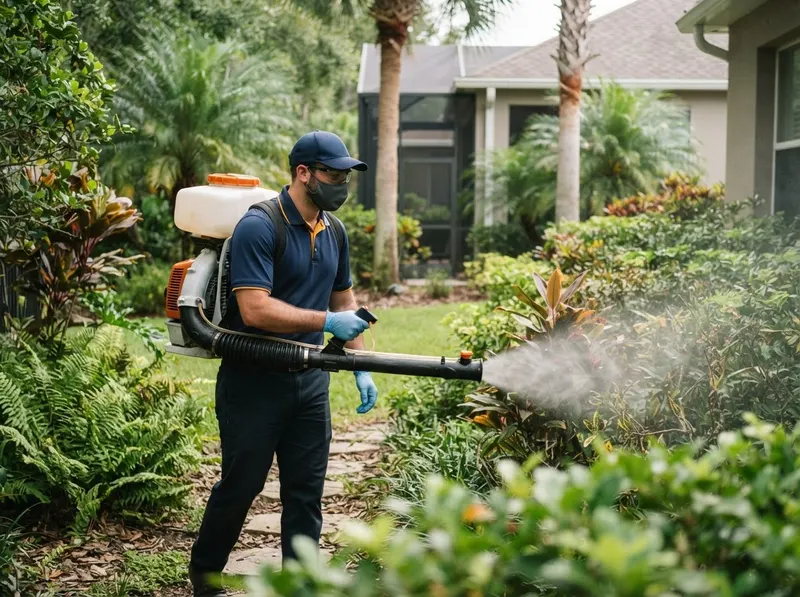
Orlando properties in waterfront and shaded communities like Baldwin Park, Delaney Park, and Dr. Phillips face extreme pressure from Culicoides midges (commonly called no-see-ums) and floodwater mosquitoes. Central Florida's subtropical humidity and regular afternoon downpours create shallow moisture microclimates in bromeliads, leaf litter, and shaded turf. Standard broadcast surface sprays degrade rapidly under high solar radiation and wash away during daily rain cycles, leaving outdoor living spaces vulnerable within 72 hours. Suppression requires dual-action treatment: interrupting the larval maturation cycle in localized water films and applying polymer-bonded adulticides to the undersides of broadleaf foliage where midges and mosquitoes rest during daylight heat.
A targeted biological barrier fits suburban parcels near lakes, retention ponds, and low-flow drainage easements, such as those found throughout Lake Nona and Hunter's Creek. In contrast, whole-yard thermal fogging or open misting systems disperse unregulated airborne particulates that compromise natural pollinators, irritate canine respiratory tracts, and fail to neutralize egg rafts embedded in organic mulch. The trade-off between thermal adulticide fogging and targeted residual barrier treatment centers on longevity versus immediate airborne knockdown: thermal fogging clears active swarms for roughly 48 hours, whereas bonded microencapsulated ground applications adhere to structural soffits, dense shrubbery, and patio perimeters to maintain active eradication for 21 to 30 days.
Structural moisture pockets near College Park bungalows and Audubon Park garden landscapes create distinct breeding zones that require manual larvicide deployment rather than chemical overspray. Bacillus thuringiensis israelensis (BTI) tablets are placed into non-draining birdbaths, gutter pans, and ornamental plant basins to target aquatic larvae before pupation occurs. Technicians conduct an inventory of drip lines, foundation air-conditioning condensate drains, and low-lying soil grades near MetroWest and Rosemont properties to eliminate the capillary moisture feeding persistent midges. All formulations dry completely within 30 minutes, forming an odorless protective shield that will not track into indoor living spaces or disrupt enclosed central air conditioning systems.
Every job gets a firm, written price after a free on-site visit.
Tell us about your mosquito and biting midge suppression job in Orlando and we'll send a clear, written quote, usually the same day.
 BugVault Pest Control